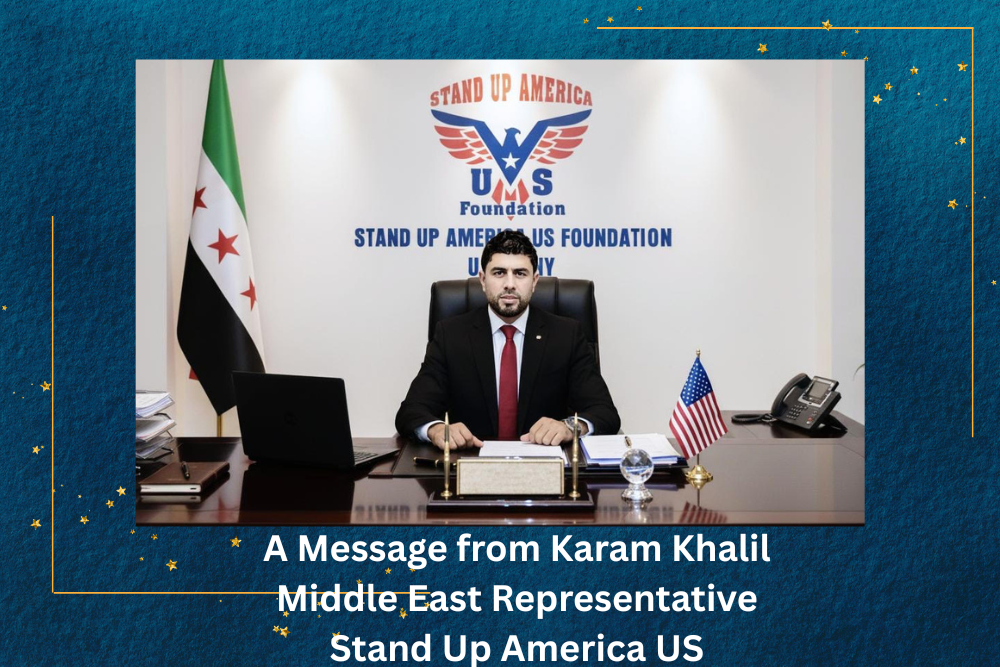
Prepared by Karam Khalil
Senior Security & Political Advisor — Stand Up America (Middle East)
From Hormuz to NATO: How a Regional Threat Is Accelerating the Restructuring of the International Order
Iran did not suddenly become a threat—it was allowed to evolve into one.
The core problem has never been Iran’s capabilities, but the international hesitation that enabled it to convert geography, energy, and chokepoints into instruments of coercion. What we are witnessing now is not escalation, but delayed correction.
Iran no longer behaves as a conventional regional state operating within a system—it operates as a pressure model. It weaponizes strategic geography, leverages proxy networks, and treats global energy flows as tools of influence. The Strait of Hormuz is not just a passage—it is a systemic stress test for the international order.
The strategic failure of the international community lies not in underestimating Iran’s power, but in misunderstanding its operating logic. Every instance where deterrence is replaced by negotiation, and pressure by accommodation, transforms a manageable threat into a self-replicating one. Hormuz, therefore, is not a maritime issue—it is a structural one.
In this context, the threat to close or disrupt the Strait is no longer an effective lever—it is a catalyst. States do not remain indefinitely exposed to chokepoints; they adapt. Each Iranian escalation accelerates the development of alternative routes, supply chains, and energy corridors. In doing so, Iran converts its leverage into a driver of its own marginalization.
Washington understands this dynamic. What appears as hesitation is not the absence of strategy—it is a shift in strategic method. The United States is moving away from direct crisis management toward reshaping the environment that produces those crises. The objective is not only to contain Iran, but to erode its structural relevance.
The emerging U.S. approach is clear:
Do not simply confront the threat in its current form—prevent its regeneration. This is achieved by compelling allies to diversify energy routes, assume greater security responsibility, and reduce systemic dependence on vulnerable geographies. Iran’s behavior is thus being turned into a liability rather than a bargaining chip.
In contrast, Europe reflects a deeper strategic deficiency—not just weakness, but avoidance. Key actors, most notably Emmanuel Macron, present engagement as rational diplomacy, yet in practice normalize coercion. Stability is being purchased in the short term at the cost of long-term structural vulnerability.
This is not diplomacy—it is strategic deferral.
Treating Iran as a necessary interlocutor in securing maritime passage does not resolve the threat; it institutionalizes it. Each accommodation reinforces the precedent that pressure yields legitimacy, and that coercion is a viable pathway to recognition within the system.
Within this framework, the debate over the future of NATO must be understood as part of a broader recalibration. Adjusting NATO’s role is not dismantlement—it is burden redistribution. The United States is no longer willing to underwrite a security architecture unmatched by proportional European commitment.
If Europe fails to develop credible independent defense capacity, it will not remain a strategic partner—it will become a strategic vacuum. Such a vacuum will not remain neutral; it will be exploited by powers such as Vladimir Putin and Xi Jinping, reshaping the balance of power beyond Western control.
Amid these shifts, Syria emerges as a critical variable in limiting Iranian reach. It is no longer functioning as a strategic corridor for Iranian expansion, but is repositioning toward neutrality and state consolidation. Restricting logistical pathways has effectively disrupted one of Tehran’s key geopolitical linkages.
This transition carries broader implications. The loss of connective geography weakens Iran’s ability to translate influence into sustained regional power. What is eroding is not just territorial reach, but operational continuity—the ability to project and sustain power across multiple fronts.
The global system is not facing a maritime crisis in Hormuz—it is facing a delayed inflection point. The central question is no longer whether Iran poses a threat, but whether the conditions that allow that threat to regenerate will be dismantled—or tolerated.
For Washington, the strategic arena is not confined to the Gulf—it lies in shaping the post-crisis order. For Arab states, the challenge is no longer balancing power, but reducing exposure to coercion. For Europe, the choice is existential: evolve into a strategic actor, or remain a contested space.
Strategic Judgment
States are not excluded from the international system because they are weak—but because their behavior compels others to build a system that no longer requires them.