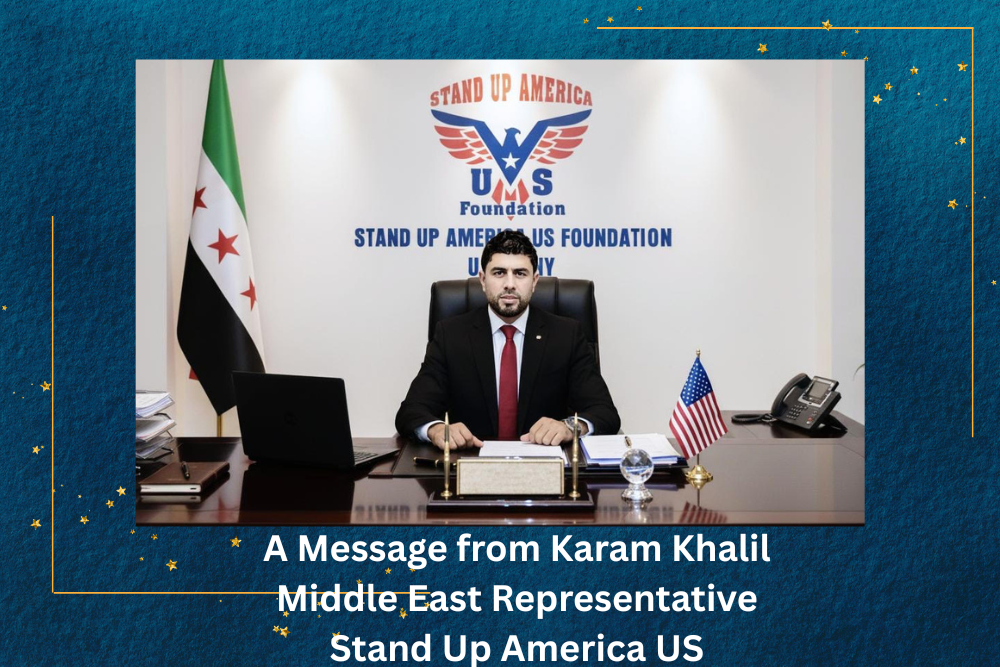
A Strategic Assessment of the Militia’s Decline and the Shifting Balance of Power in the Levant
By Karam Khalil
Senior Political & Security Advisor – Stand Up America US
Hezbollah’s armed presence is no longer a Lebanese internal dispute—it is the central obstacle to state sovereignty, regional stability, and the entire security architecture of the Levant.
The 2023–2025 conflict exposed structural weaknesses inside the militia and accelerated the collapse of its political, military, and logistical depth following the fall of the Assad regime.
This assessment examines Hezbollah’s hybrid identity, its weaponized political role, its integration into Iran’s regional agenda, and the strategic implications of its weakening position.
I. Hezbollah’s Hybrid Identity: Party, Militia, and Foreign Proxy
Hezbollah operates simultaneously as:
- A political party embedded within Lebanese state institutions;
- A military-security force equal to a medium-sized army;
- Iran’s most valuable regional arm, executing Tehran’s cross-border agenda.
The doctrine of Wilayat al-Faqih places ultimate authority in Tehran, not Beirut, making Hezbollah an ideological instrument rather than a national Lebanese actor.
II. The Weapon as Political Dominance, Not National Defense
Hezbollah’s arsenal transitioned from a self-declared “defensive necessity” into a mechanism for internal domination:
- Armed takeover of Beirut and Mount Lebanon in May 2008.
- Forcing Lebanon into the Syrian war.
- Opening the northern front with Israel in 2023–2025 with no state authorization.
The militia’s weaponry effectively grants it a permanent veto over Lebanon’s presidency, government formation, foreign policy, and war decisions.
III. The Parallel Security State: Unit 121
Unit 121—Hezbollah’s covert assassination and coercion arm—illustrates the militia’s transformation into a security state operating above the law:
- Car bombings, poisonings, kidnappings, torture, staged “accident” killings.
- Media operations designed to intimidate, discredit, and isolate targeted individuals.
This apparatus erodes judicial sovereignty and creates a climate of fear across Lebanon.
IV. The War of 2023–2025: Collapse of Hezbollah’s Military Myth
The conflict revealed unprecedented structural fractures:
- Thousands of elite fighters killed, including Radwan units.
- Leadership decapitation through precision strikes, including the killing of Tabatabai.
- Massive displacement and socio-economic collapse inside Hezbollah’s demographic base.
The “invincible resistance” narrative has been replaced by internal exhaustion and silent dissent within the Shiite community.
V. The Fall of Assad: The Most Devastating Strategic Blow
Assad’s collapse in December 2024 severed Hezbollah’s logistical artery:
- The Syria–Lebanon–Iran corridor disintegrated.
- Hezbollah’s supply chain, storage network, and transit routes collapsed.
In response, Hezbollah adopted a destabilizing internal strategy:
A. Absorbing Assad’s fleeing officers
These officers were granted forged documents and integrated into:
- Local missile production facilities;
- Captagon networks;
- Covert operations aimed at destabilizing post-Assad Syria to reopen supply routes.
B. Transforming Lebanon into a “Miniature Assad State”
Hezbollah replaced regional supply lines with internal production:
- Drug manufacturing
- Arms workshops
- Smuggling networks
- Illicit finance
This is not “recovery”—it is Lebanon’s conversion into a hub for Iranian rockets, narcotics, and remnants of Assad’s security apparatus.
VI. Regional Implications: Why Disarming Hezbollah Ends Iran’s Leverage
Hezbollah is Iran’s most strategic regional asset. Its arsenal enables:
- Pressure on Israel’s northern border;
- Command and coordination of militias in Iraq, Yemen, and Gaza;
- Negotiating leverage in nuclear and sanctions discussions.
Thus, disarming Hezbollah removes Iran’s decisive role in Lebanon, Syria, and the Levant.
VII. Israel’s Strategic Objective: Capabilities Neutralization
Israel is not currently aiming to eliminate Hezbollah as a political actor.
Its real objective is to:
- Destroy missile depots;
- Decapitate military command structures;
- Cripple the militia’s operational capabilities while leaving a weakened political entity.
A militarily paralyzed Hezbollah is less destabilizing than a sudden vacuum.
VIII. The Most Dangerous Trajectory: A Regional War on Lebanese Soil
Failure to resolve the weapons issue may trigger:
- Israeli ground operations approaching Beirut;
- Influx of Iraqi and Yemeni militias;
- Total collapse of Lebanon’s already fragile economy.
Lebanon now faces a binary choice:
- Reassert state authority and enforce disarmament, backed by Arab and international support.
- Or surrender to militia rule, risking a devastating war that could dissolve Lebanon as a functional state.
IX. A Syrian Strategic Reading of Lebanon’s Crisis with Hezbollah
From my vantage point observing regional transformations after the fall of the Assad regime, Hezbollah’s crisis mirrors—at a magnified scale—the dynamics that collapsed Syria:
- Reliance on weapons as political identity;
- Replacement of the state with a security apparatus;
- Submission to an external agenda too large for national capacity.
Hezbollah is now at the same crossroads
My conclusions:
- As long as Hezbollah retains its weapons, Lebanon remains hostage to the strategic calculations of Tehran and Tel Aviv—not its own national interests.
- Disarmament exposes decades of assassinations, smuggling, and regional destabilization carried out under the banner of “resistance.”
- Iran cannot replace Hezbollah’s strategic value elsewhere:
- Yemen is drained and geographically irrelevant to Israel.
- Iraq is fractured and politically shifting away from Tehran.
- The demonstrated vulnerability of Hezbollah and the Houthis under concentrated strikes has shaken regional
- Shiite perceptions of Iran’s promises.
4. This moment represents a historic opportunity:
- For the Arab world to restore Lebanon’s sovereignty;
- For Lebanese national forces to rebuild a social contract grounded in the exclusive authority of the state;
- For the international community to condition any aid on decisive action regarding Hezbollah’s weapons.
Hezbollah is today not merely a Lebanese challenge—it is a regional liability and a prisoner of Iran’s shrinking geopolitical margin.
Lebanon stands at a decisive juncture:
Either the logic of the state prevails… or the logic of the militia consumes what remains of the republic.