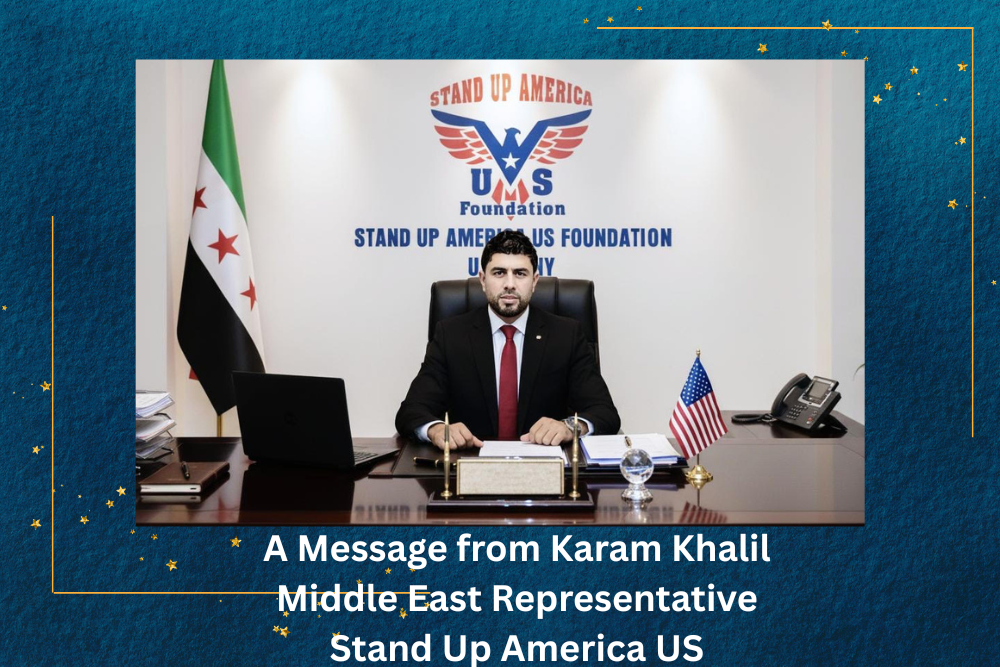
By Karam Khalil
Senior Security–Strategic Advisor
Stand Up America US Foundation
Introduction: Not a Raid, but a Doctrinal Shift
At dawn on January 3, 2026, Caracas did not witness a conventional military strike.
What occurred was a declaration of the return of the decisive state model: a sovereign decision executed rapidly, then announced politically as a fait accompli, before any meaningful diplomatic opposition could form.
This is not a story about Venezuela as a country.
It is about a decision-making paradigm.
A logic that states: when a state becomes a threat platform, the crisis is not managed—it is closed.
1) “Shock and Silence”: From Awe to Paralysis
According to leaked American accounts, the operation was not designed for mass destruction, but to paralyze the state’s nervous system: command and control, communications, and response capability.
Operational reporting spoke of extensive air support and the role of Delta Force as the ground execution instrument at the moment of apprehending the target.
This shift matters deeply to decision-makers in the Middle East.
Because Washington is no longer saying “we will apply pressure.”
It is saying: when conditions for decisive resolution exist, we will end the file.
2) Why Maduro? Oil, Chokepoints, and the Meaning of “Economic Security”
Those who reduce the operation to slogans about “democracy” or “narcotics” miss its core logic.
Venezuela, by virtue of its oil reserves, represents a geo-economic strategic reserve at a fragile global moment—one in which energy has become a weapon and maritime chokepoints have become tools of coercion, foremost among them the Strait of Hormuz.
If Iran and its proxies are capable of threatening supply lines, then possessing massive alternatives—reserves, production capacity, and export routes—becomes a matter of national security.
Caracas must therefore be read within a broader architecture: securing the economy of power before the economy of shock detonates.
3) The Deeper Strike: Exposing Russian Deterrence and Disabling the Iranian Umbrella
The true shock was not merely the apprehension itself, but what the event revealed about the balance of deterrence.
Air defense systems, military institutions, and Russian–Iranian allied networks appeared incapable of preventing the decisive moment or disrupting its trajectory.
The message here is dual and unambiguous.
To Moscow: your weapons do not block our decision when a file becomes a strategic priority.
To Tehran and its proxies, including the Houthis: geographic distance does not create immunity when the decision is closure.
4) Human Intelligence: When the Source Becomes More Powerful Than the Missile
In high-value target operations, technology alone is insufficient.
American accounts point to internal penetration and real-time human intelligence that enabled precise identification of the target’s lifestyle patterns and location at the decisive moment.
This lesson is no less important than that of advanced munitions.
Because sovereign apprehension does not descend solely from the sky—it proceeds through breaking the security loop from within: HUMINT, SIGINT, temporal dominance, then surgical execution.
This is not new in American doctrine.
The same logic governed the elimination of ISIS leader Abu Bakr al-Baghdadi, where human intelligence was decisive in determining place and timing.
It is the same logic that shaped the decision to strike Qassem Soleimani and Abu Mahdi al-Muhandis, where a precise strike that closed the file was preferred over an open-ended escalation.
Across all these precedents, the message is consistent: when a target becomes a strategic threat node, the node is closed, not managed.
5) Trump and Deterrence: The Return of the Decisive State, Not the Management of Hesitation
I do not write from a position of neutrality, nor do I subscribe to the school of cosmetic weakness.
What Trump demonstrated here was the reactivation of deterrence through action, not deterrence through rhetoric, hesitation, or ambiguous signaling.
By contrast, the Obama era— in my assessment—was characterized by strategic hesitation constrained by lobby pressures and bureaucratic paralysis, during which the region was left to burn and Iran and its proxies were allowed to expand.
The Biden era then followed as a phase of weakness and soft management, in which American influence eroded and adversaries grew emboldened to test red lines.
The result was an expanded Iranian appetite, escalating Houthi threats to maritime routes, and greater operational space for Russia—which devastated Syria and its people to protect Assad—to extort and obstruct.
6) From Caracas to the Middle East: Reengineering Power Through Economics
The emerging logic is not that of endless wars, but of concentrated power and calibrated objectives.
Recent American strategic documents and policy thinking place the economy, industrial capacity, and supply chains at the heart of national security, reordering priorities around a “national interest first” framework.
Practically, this means Washington seeks a Middle East governed by partnership and investment—but with a non-negotiable condition: no hostile power may dominate energy routes or chokepoints.
When Iranian and proxy threats evolve into global economic coercion, deterrence tools are transformed into file-closing instruments rather than crisis-management mechanisms.
7) Iran and the Houthis: Testing Deterrence and the Collapse of the “Restraint” Illusion
Iran, in my view, is not a normal state in its regional conduct.
It is a sectarian–militia expansion project that hollows out states from within, then negotiates with the world using chaos as leverage.
The Houthis are not an innocent local movement.
They are a maritime and political threat arm, targeting energy security and transit routes to impose a binary equation: concession or disruption.
The success of the Caracas model sends them a message they understand.
Escalation is not countered with rhetorical patience, but with an overt capacity to move the battle to the appropriate arena, at a time of Washington’s choosing.
8) Russia: From the Destruction of Syria to the Extortion of Global Balance
Russia was never a mediator in Syria.
Russia functioned as a protection machine for a regime that killed its own people, contributing to the destruction of cities, infrastructure, and human life, solely to preserve a ruler and reproduce influence by force.
Those who wager on partnership with this model purchase loss.
The emerging equation signaled by Washington is to narrow Moscow’s margins, drain its gains, and transform it from a power that dictates terms into one that is managed within limits.
9) Recommendations for Decision-Makers: Real Partners, Not Temporary Proxies
If “After Caracas” defines a phase, then the Middle East requires a clear approach.
First: sovereign partners capable of enforcing control on the ground—one state, one army, one decision.
Second: strike proxy economies before their platforms—financing, smuggling, support networks, and ports.
Third: deter Iran without hesitation—deterrence is action, not statements, and the file-closing equation must remain credible.
Fourth: neutralize the Houthis as a maritime threat—protecting transit routes is global economic security, not a political option.
Fifth: clip Russia’s influence—no reward for those who destroyed Syria; instead, contain influence and seal gaps.
Sixth: link security to investment—stability emerges when partnerships translate into projects, infrastructure, and opportunity that draw societies away from militias and back to the state.
Conclusion: The World Has Entered the Era of Closure, Not Management
“Southern Spear” is not a one-night story in Caracas.
It is a clear declaration that the United States is returning to the model of the state that ends files, not the state that explains, hesitates, or allows its deterrence to erode under proxy pressure.
The coming phase, as I see it, will not be wars of occupation, but a sequence of decisions.
Files will be closed when capability intersects with interest, and when the region contains genuine partners capable of transforming deterrence from a moment into a system of stability.